

Change in Licence Policy for CAAS Journals
We would like to inform you that the journals published by the Czech Academy of Agricultural Sciences (CAAS) will change their licence policy. All articles submitted to CAAS journals from 2026 will be published under the Creative Commons Attribution 4.0 International Licence (CC BY 4.0).
The Creative Commons Attribution 4.0 International Licence (CC BY 4.0) allows broad reuse, distribution, and adaptation of published articles, provided that appropriate credit to the original authors is given.
Articles submitted by 2025 are distributed under the Creative Commons Attribution-NonCommercial 4.0 International (CC-BY-NC 4.0) license.
Impact factor (WoS):
2024: 1.8
Q2 – Economics; Q2 – Agricultural Economics & Policy
5-Year Impact Factor: 1.9
SCImago Journal Rank (SCOPUS):
Agricultural Economics
- ISSN 0139-570X (Print)
- ISSN 1805-9295 (On-line)
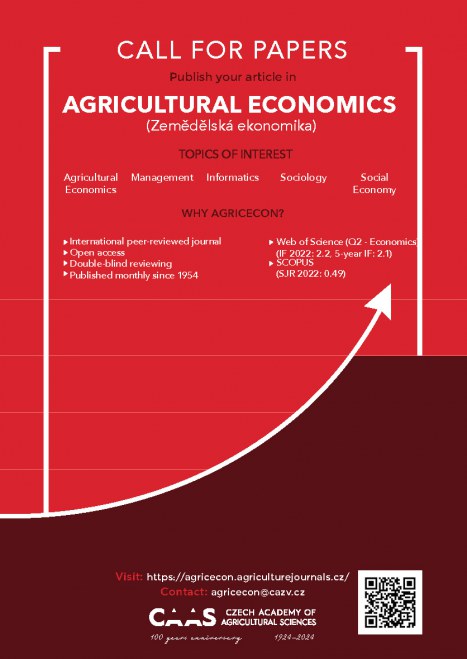
An international open access peer-reviewed journal published by the Czech Academy of Agricultural Sciences and financed by the Ministry of Agriculture of the Czech Republic. Published since 1954 (by 1999 under the title Zemědělská ekonomika)
- The journal is administered by an international Editorial Board
- Editor-in-Chief: prof. Ing. Lukáš Čechura, Ph.D.
- Co-editors: Ing. Jaroslav Pražan, Ph.D., prof. Ing. Jindřich Špička, Ph.D., doc. Ing. Pavla Vrabcová, Ph.D.
- Executive Editor: Ing. Zdeňka Náglová, Ph.D.
- Technical Editor: MgA. Hana Slaninová
- The journal is published monthly
Aims & Scope
The journal publishes scientific articles: original scientific papers dealing with agricultural subjects from the sphere of economics, management, informatics, ecology, social economy and sociology. An extensive scope of subjects in fact covers the whole of agribusiness, that means economic relations of suppliers and producers of inputs for agriculture and food industry, problems from the aspects of social economy and rural sociology and finally the economics of the population nutrition. Papers are published in English.
Current issue
Index of contents volume 71Editorial
Editorial Department
Agric. Econ. - Czech, 2025, 71(12):I-III 
Editorial to the thematic issue: "Bioeconomic strategies and systems as tools for achieving sustainable agriculture and rural development"Editorial
Eva Cudlínová, Miloslav Lapka, James Sanford Rikoon
Agric. Econ. - Czech, 2025, 71(12):629-632 | DOI: 10.17221/540/2025-AGRICECON
Revealing key links between components in the circular economyOriginal Paper
Carmen Eugenia Nastase, Gabriela Prelipcean, Carmen Emilia Chasovschi, Mariana Lupan, Ruxandra Bejinaru
Agric. Econ. - Czech, 2025, 71(12):633-646 | DOI: 10.17221/277/2024-AGRICECON
The circular economy (CE) has proven to be an effective solution for sustainable development in the last two decades, especially in the context of multiple crises. As a long-term strategy, business managers are seeking a sustainable business model that harmoniously and efficiently integrates prosperity, social security, and resource conservation. This research highlights the essential role of components such as green logistics (GL) and green human capital (GHC) in sustainable production (SP), which is necessary for the successful implementation of CE. The study, based on data collected from 117 companies in the Romanian food industry, uses partial...
Modelling the circular bioeconomy in the palm oil industry: Emerging approaches to address cattle feed shortages in IndonesiaOriginal Paper
Atien Priyanti, Priyono, I Gusti Ayu Putu Mahendri, Dwi Yulistiani, Hotmatua Daulay, Yuhendra, Nasir Rofiq, Astu Unadi, Uning Budiharti, Adji Parikesit, Arsyadi Ali, Edi Erwan, Muladno
Agric. Econ. - Czech, 2025, 71(12):647-663 | DOI: 10.17221/231/2024-AGRICECON
Indonesia is presently ranked as the first crude palm oil producer in the world. However, the palm oil industry faces significant challenges, including extensive criticism related to environmental degradation and social impacts. The circular bioeconomy concept emphasises sustainable production and consumption through the repurposing, recycling, and regeneration of resources to address these challenges. Integrating palm and cattle farming represents a promising approach to enhancing resource efficiency and sustainability in agricultural systems. This study employs a system dynamics analysis to model the circular bioeconomy in the palm oil industry,...
Deconstruction of China's agricultural bioeconomy policies in the context of sustainable systems transition – Based on policy texts analysisOriginal Paper
Xiuxiang Li, Yanhan Hu
Agric. Econ. - Czech, 2025, 71(12):664-679 | DOI: 10.17221/423/2024-AGRICECON
Countries are calling for a sustainable transition of agri-food systems due to the volatility of food security in the context of climate change, and the agricultural bioeconomy may be a more dependable solution. By capturing, coding, and displaying word clouds of Chinese agricultural bioeconomy policy texts, this study deconstructs the development framework of China's agricultural bioeconomy policies based on the agricultural biosystem dimension, the policy instrument dimension, and the comprehensive dimension. It concludes that there is a clear trend of sustainable transformation and cross-sectoral linkage in China's agricultural bioeconomy policies....
Closed-circle bioeconomy: Applied aspects of agricultural implementationReview
Yelizaveta Chernysh, Viktoriia Chubur, Miroslav Hájek, Hynek Roubík
Agric. Econ. - Czech, 2025, 71(12):680-690 | DOI: 10.17221/36/2025-AGRICECON
In the face of global challenges, innovative methods of production and consumption are vital, and the bioeconomy signifies a transformational shift based on biological processes, minimal energy use and full integration of resources into ecosystems. This study focused on a sectoral analysis of bioeconomy opportunities with a focus on bioenergy and waste management in an agriculture sustainable approach. Literature-based analysis was used to approach the research objectives of the roadmap design methods. A comprehensive sectoral analysis of the bioeconomy was conducted with a special emphasis on bioenergy and food security. A conditional roadmap of bioeconomy...